.png)
33 Best Student Gratitude Questions to Transform Your Donor Stewardship Reports
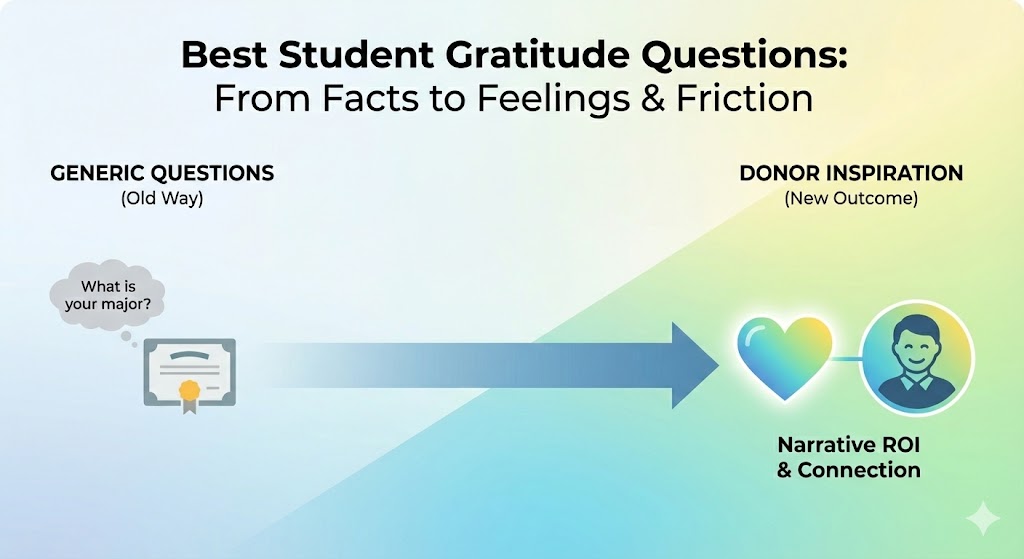
In 2026, donors are no longer satisfied with transactional "thank you" notes, and students won't answer them anyway. For directors of donor relations and scholarship offices, the challenge is moving past the generic, one-sentence student response to create student showcases that truly inspire (and are fun to respond to!).
The secret to better stewardship isn't just asking students to say "thank you"—it’s asking the right questions.
Why Traditional Student Thank You Notes Are Failing
Most universities ask: "What is your major?" or "What do you plan to do after graduation?" These lead to flat, predictable answers. To maximize donor gift inspiration, you need to pivot from facts to friction and feelings.
By asking about the obstacles a student overcame or the specific emotions a scholarship unlocked, you bridge the gap between a financial transaction and a human connection.
How Awarded Software Solves the Engagement Gap
Before we dive into the questions, it’s important to address the "how." Awarded Software streamlines the collection of these stories by:
- Automated Reminders: Sending email and text nudges to ensure high response rates.
- SIS Integration: Automatically pulling in names, majors, and hometowns so students don't have to answer redundant questions.
- Mobile-First Design: Making it effortless for students to record responses on the go.
- AI-Powered Editing: Using built-in AI tools to catch grammar issues and ensure every note is "donor-ready."
50 Best-in-Class Student Impact Questions
Here are 50 questions categorized to help you build the ultimate stewardship report.
1. The "Trajectory Pivot" (Direct Impact)
These questions highlight the "before and after" of the donor's gift, without placing undue burden on the student to go into uncomfortable detail if they wish not to.
- How has this award changed the way you view your own potential?
- What is a specific goal that felt "out of reach" last year but feels achievable today?
2. Academic Passion & Curiosity
Go beyond the major to show donors the "why" behind the student's work.
- What class or classes have you most enjoyed this year?
- If you were explaining your field of study to the donor over coffee, why would you tell them it’s important?
- If you could invite the donor to sit in on one of your classes, which one would it be and why?
- What does your "dream" research project or internship look like?
- Who is a person in your field that inspires you, and why?
- How has your perspective on your major shifted since your freshman year?
- Describe a "lightbulb moment" you had in a lab or lecture hall recently.
- What is one book or article you’ve read this year that changed your thinking?
3. Personal Growth & Resilience
Show donors the human being behind the GPA.
- How do you feel you've developed as an individual while at [institution]?
- If you had a little sibling joining [institution], what advice would you have for them?
- How do you stay motivated when your course load feels overwhelming?
- What is the most courageous thing you’ve done since arriving on campus?
- How has your definition of "success" changed since you started college?
- What is a "hidden talent" you have that your classmates might not know about?
- Describe a mentor or peer who has changed the way you think about your future.
4. Community & Belonging
Highlight the social and cultural capital of the university experience.
- Where is your "favorite spot" on campus, and what makes it feel like home?
- What student organization has made you feel like you truly belong here?
- How has being a part of this community changed your worldview?
- What is your favorite campus tradition, and why does it matter to you?
- If you could thank one person on campus, who would it be?
- What is one thing you love about this university that you might not find anywhere else?
5. Vision for the Future (Donor ROI)
Help the donor see the long-term value of their investment.
- Ten years from now, what do you think you will remember most about your time here?
- What's one big problem in the world that you'd like to use your degree to tackle in the future?
- If you could send a message to your "future self" ten years from now, what would it say?
- What kind of impact do you hope to have in your hometown after graduation?
- What is the one thing you want the donor to know about the person you are becoming?
- How do you think you've developed during your time at [institution]?
Strategies to Maximize Student Engagement
To ensure your student thank you notes are high quality, follow these three rules:
- "Describe" > "What": Open-ended prompts are harder to provide generic answers for.
- Context is King: Give the student a brief "Donor Profile" or example of why their scholarship was established before they write so they know if they are writing to a family, a foundation, or a CEO (if your platform allows for it).
- Be Thoughtful About Prompt Variety: Don't require students to answer 5+ separate prompts. You might present a few options to students and let them choose which questions to answer, which will boost the quality of the responses they do provide. You may also institute a minimum word count of 25-50 words for the questions they do answer. A few, thoughtful options ensures students answer with engaged responses while minimizing decision fatigue.
- Leverage Modern Tools: Use software like Awarded to automate the collection process so your team can focus on storytelling, not chasing down emails.
Improve Your Stewardship Today
Ready to take your donor engagement to the next level? Explore more resources on student showcasing and impact reporting on our blog.
Read more donor stewardship best practices at Awarded Software
Transform your scholarship awarding & stewardship with Awarded
Attract & retain more students and donors starting today.
.png)