

What an endowed scholarship gift agreement should include
A clause-by-clause checklist for endowed scholarship gift agreements, and the drafting and review practices that keep every fund compliant and awardable.
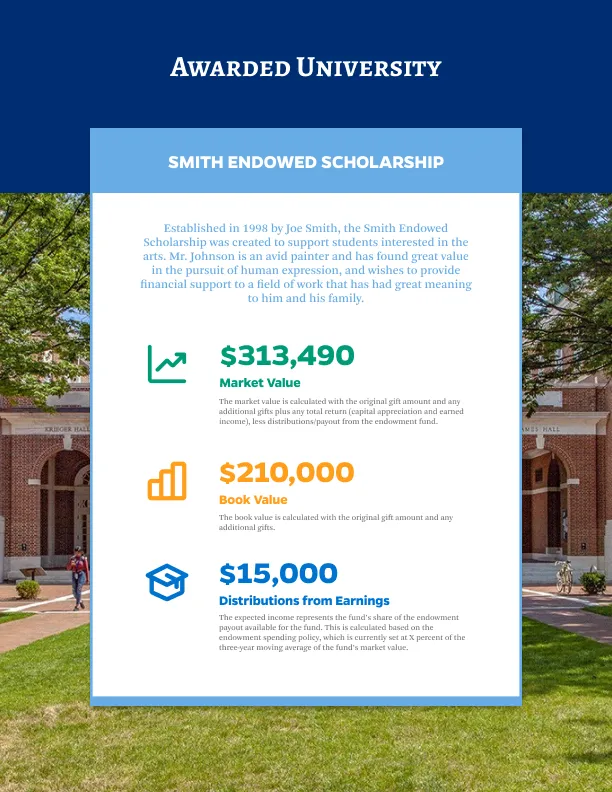
An endowed scholarship gift agreement should name the donor and fund, state the gift amount and payment schedule, describe the fund’s purpose, and write eligibility as requirements and preferences. It also needs a flexibility clause, naming terms, spending policy and reporting commitments, and signatures. Check that real students qualify before the donor signs.
Why the gift agreement decides everything later
Every scholarship you award, every fund you audit and every report you send traces back to the language in the gift agreement. When that language is too narrow, too vague or out of date, the problems show up years later: funds nobody qualifies for, restrictions nobody can administer, money that sits unawarded. An endowed fund is meant to last for generations, so the agreement has to work long after the people who wrote it have moved on.
The clause checklist
Use this list for every endowed scholarship agreement. Most institutions build these into a standard template and only allow edits in specific sections.
| Clause | What it should say | Why it matters |
|---|---|---|
| Parties and fund name | The donor’s legal name, the institution or foundation, and the official fund name | Matches the fund to the right donor and fund code in every system |
| Gift amount and schedule | Total commitment, payment dates, and what happens if a pledge is not completed | Finance needs it to book the gift; stewardship needs it to time reports |
| Endowment terms | That the gift is permanently endowed and invested with the institution’s pool | Separates endowed from current use treatment |
| Minimum to endow | The amount required before awards begin, and how awards are made until then | Prevents confusion when the fund isn’t fully funded yet |
| Spending policy | That annual distributions follow the institution’s endowment spending policy | Sets donor expectations about how much will be awarded each year |
| Purpose | One or two plain sentences on what the fund supports | The clause everyone will reread in 20 years |
| Requirements | The criteria a student must meet to be eligible | Defines the eligible pool |
| Preferences | Criteria that decide priority among eligible students, written explicitly as preferences | Keeps the pool broad while honoring the donor’s wishes (more on requirements vs preferences) |
| Selection | That the institution selects recipients, with any donor role limited to advising on criteria | Protects the gift’s charitable status |
| Flexibility clause | What the institution may do if the purpose can no longer be met, such as redirect to the closest related purpose | Avoids court petitions when programs change |
| Naming | How the fund is named and what happens if naming needs to change | Prevents disputes later |
| Reporting and stewardship | What the donor will receive and how often, such as an annual endowment report | Sets a commitment your team can actually keep |
| Unspent funds | What happens if no eligible student is found in a given year | Stops funds from sitting idle by default |
| Governing law and policies | Reference to institutional gift acceptance policies | Gives counsel the framework |
| Signatures | The donor and the institutional signatories required for a gift of this size | Makes the agreement executable |
Keep the donor’s story and biography in a separate document. The gift agreement is the legal record of the gift.
Write criteria that real students can meet
Before the agreement is final, count how many current students would meet all the requirements together. Each criterion can sound reasonable alone: a major, a class year, a hometown, a minimum GPA. Stacked together, they can leave one eligible student, or none.
A good rule of thumb: requirements define who can receive the award, and preferences decide who goes first. If the donor cares about students from a particular county, write it as a preference. The fund stays awardable in years when nobody from that county enrolls.
Also avoid terms nobody can measure, such as “deserving” or “well-rounded.” If the donor wants character considered, describe how: a short essay, a recommendation, or committee review.
Screen every draft three ways
Donor Relations Group (DRG) frames the test for any restriction as legal, possible and practical. In practice, screen each draft for:
- Legality. Restrictions based on race, sex, national origin, religion or other protected characteristics, and proxies for them. Your general counsel sets how conservative this screen should be. This is general information, not legal advice; check with your general counsel.
- Feasibility. Programs that still exist, enough eligible students, and criteria your institution actually collects.
- Documentation. Every required clause from the checklist above is present and complete.
Resolve legal problems before the agreement moves forward. It is much easier to change language with a donor before signing than to amend an executed agreement later. The fund audit checklist covers the same checks for agreements already signed.
Review practices that keep agreements moving
The drafting process matters as much as the template. These practices come from Lynne Wester of Donor Relations Group and from the gift administration teams we work with, several of them discussed in DRG’s Meet GATO webinar.
- Make compliance continuous. Check language while the agreement is drafted and every time it changes. One manual legal review at the end catches problems too late.
- Protect legal-approved clauses. Lock the standard language your Office of General Counsel approved, and explain why it’s locked so reviewers know what they can and can’t change.
- Route only the relevant sections. A dean may only need to approve the purpose and criteria. Leadership shouldn’t have to read every paragraph.
- Name delegates. Give reviewers a deadline. If someone is out, the draft moves to their delegate instead of waiting.
- Set signatories by rule. Decide who signs based on gift size, fund type or unit, such as gifts above a set amount going to the president.
- Let donors comment instead of redlining. Donors review the language and send comments or questions. Your team makes the changes, so the agreement stays on your template.
- Don’t use the agreement as a proposal. In Lynne Wester’s words, a gift agreement is not a proposal. The back and forth about what the gift will do belongs before drafting. Agreements should go out when they are ready to sign.
After signing: store, track and remediate
Store the signed agreement where everyone who administers the fund can find it. Best practice is to attach it to the donor’s record in your CRM and to the fund, so financial aid, finance and donor relations work from the same document. Check that the signed copy matches the last approved draft.
Then make sure the criteria in your awarding system match the signed language. This is where a lot of donor intent gets lost.
Finally, deal with undocumented funds. Most institutions have funds with a fund number and no agreement. Write a memo to file that records the fund’s history, how it has been used and the rationale for its current criteria, and have the right people sign off.
How Awarded helps
GATO takes every gift agreement from intake to signature. Gift officers fill in an intake form, GATO drafts from your templates with protected clauses, and every draft is screened for legality, feasibility and missing clauses. You can see roughly how many current students would qualify, using aggregated SIS data, before the agreement goes out. Internal approvals follow saved routes, donors review and reply by email without logging in, and the signed record is kept with the fund. Because GATO is built by the same team as Awarded’s Scholarship Awarding, Fund Audits and Donor Reporting, the terms a donor signs stay visible for the life of the fund.
Frequently asked questions
What is the difference between an endowed and a current use scholarship agreement?
An endowed agreement creates a permanent fund. Only the annual distribution under the spending policy is awarded. A current use agreement covers money meant to be spent, usually within a set period, so it needs a spending timeline in place of endowment and spending policy terms.
Should a gift agreement include a minimum GPA?
Only if the donor insists, and preferably as a preference. A minimum GPA requirement combined with other criteria can shrink the eligible pool quickly. Check the student count before signing.
Can the donor be on the selection committee?
Institutions generally keep final selection authority to protect the gift’s charitable status. Donors can help shape criteria. This is general information, not legal advice; check with your general counsel.
What is a flexibility clause?
A flexibility (or variance) clause lets the institution redirect the fund to the closest related purpose if the original purpose becomes impossible, illegal or impractical. Without one, changing the purpose may require the donor’s consent or a court petition.
Amaan Badruddin is the CEO of Awarded Software, the scholarship management and financial stewardship platform used by 100+ campuses. He founded Awarded in 2022 to change how scholarships are awarded and managed across U.S. higher education, helping financial aid and advancement teams put donor funds to work and show donors their impact. He studied at Northwestern University and is based in Brooklyn, New York.
Follow on LinkedIn