

How to find and spend unspent restricted funds
Why restricted funds sit unspent, how to measure fund utilization, and a practical plan to set spending targets and spend down accumulated surplus.
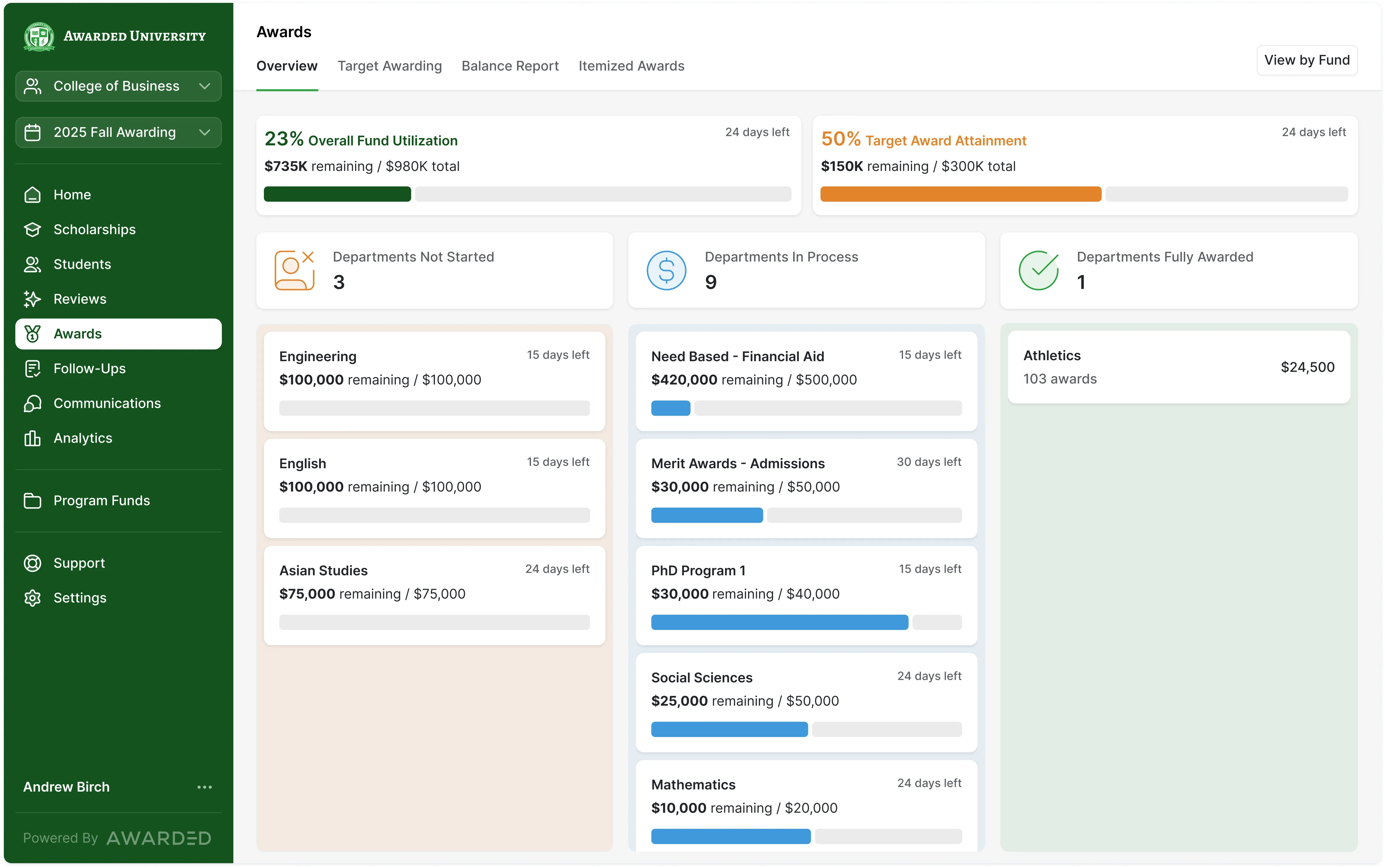
To find unspent restricted funds, compare each fund’s spendable balance with what was actually spent or awarded this year, fund by fund. Then find out why the gap exists. Most unspent money comes from a few causes: units spending only current earnings, extra restrictions, informal reserves, too few eligible applicants, and general funds being spent first.
Why restricted funds sit unspent
Restricted funds usually go unspent because nobody owns the gap between the balance and the awards. The same handful of causes shows up at almost every campus we work with.
- Units on autopilot. A department spends roughly what it spent last year, or only the current year’s endowment payout. Nobody looks at the balance that built up in earlier years. Spend slightly less than earnings for five years and the surplus compounds into a large, awkward number.
- Restrictions added beyond donor intent. The gift agreement says “a student in the College of Engineering with financial need.” Somewhere along the way, a spreadsheet turned that into “a junior in mechanical engineering with a 3.5 GPA.” The fund is now harder to award than the donor ever asked for. Our post on scholarship requirements vs preferences covers how this happens.
- Rainy-day reserves. Fund managers keep a cushion “just in case.” A small reserve is reasonable. Applied to every fund, every year, it becomes a pattern of underspending that nobody decided on.
- Too few applicants, or eligible students who never apply. A fund that depends on an application can only award students who apply. Many eligible students never do, often because they don’t know the fund exists or assume they won’t qualify.
- General funds spent first. Some units spend unrestricted or operating dollars first because they’re easier to use. The restricted fund waits for a “right” recipient who never quite arrives.
The utilization problem goes deeper on why this matters for students and donors.
How fund utilization is calculated
Fund utilization is the amount spent or awarded from a fund divided by that fund’s budget for the year. The hard part is choosing the right budget.
| Fund type | Budget to measure against | Common mistake |
|---|---|---|
| Endowed fund | The annual payout (spendable amount) set by finance, usually a percentage of market value under your endowment spending policy, plus any accumulated surplus you plan to spend | Measuring against market value or corpus, which can never be spent |
| Current use fund | A spending target or spending plan for the year | Measuring against the full balance, which makes a multi-year gift look unspent in year one |
| Fund with accumulated surplus | The year’s target plus the portion of surplus scheduled for this year | Ignoring the surplus entirely, so a fund looks “on track” while cash keeps building |
A worked example: an endowed scholarship has a $40,000 payout this year and $60,000 of accumulated surplus that finance wants spent over three years. This year’s budget is $40,000 plus $20,000, or $60,000. If the fund awarded $45,000, utilization is 75%, even though the fund spent more than its payout.
Set spending targets that people will actually hit
A spending target turns “spend this money” into a number each fund manager can track. Targets work best when finance sets the rules and the people closest to the fund set the plan.
For endowed funds:
- Start with the payout from your spending policy. That is the minimum you should expect to spend each year.
- Add a scheduled share of any accumulated surplus. Many finance offices pick a simple rule, such as clearing the surplus over two to four years, and only make exceptions with a stated reason.
- Revisit the target every time the payout changes.
For current use funds:
- Set a plan based on the donor’s timeline. A five-year pledge for a program usually means spending about a fifth each year, adjusted for when gifts arrive.
- Cap the plan at the available balance, so nobody plans to spend money that hasn’t come in.
- Flag current use funds with no activity for a year or more. These are often the easiest wins.
One finance lead at a large university foundation put it well: if you only look at the target spend, you miss most of the cash that could be spent. Show fund managers both numbers, the target and the total available, and the conversation changes.
Build a dashboard for unspent, dormant and surplus funds
Most institutions can’t fix what they can’t see. A useful fund management dashboard shows four lists side by side, because the categories overlap:
- Unspent this year. Funds behind their target with the deadline approaching.
- Dormant. Funds with no awards or expenses for two or more years.
- Accumulated surplus. Funds whose balance keeps growing faster than they spend.
- Compliance risk. Funds whose restrictions may be illegal, unworkable or out of date. A fund audit finds these.
Give each fund manager a view of only their own funds, with the gift agreement attached so they can check the purpose before spending. Leadership should see the whole portfolio, sorted by dollars at stake. Start with the departments that hold the most unspent money. A few departments usually account for most of it.
A practical plan to spend down unspent funds
Spending down restricted money works best as a repeatable process. Here is the sequence that works:
- Pull one list. Combine balances from finance, fund purposes from the gift agreements, and awards from financial aid, matched by fund code.
- Read the restriction again. Compare what the donor wrote with how the fund is being administered. Remove any restriction the donor never asked for.
- Find the students. For scholarships, match funds against student data from your SIS so eligibility doesn’t depend only on who applies. This is where most scholarship funds unlock.
- Set a target and a date. Every fund gets a number and a deadline that the fund manager agrees to.
- Send reminders before the deadline. Remind fund managers while there is still time to act, well before the fiscal year closes.
- Fix what can’t be spent. If no student can meet the criteria, talk to the donor, amend the agreement, or use a variance clause if the agreement has one. Talk to your general counsel first.
- Tell the donor. When a fund is fully spent, the donor report is the proof. When it isn’t, explain why and what you’re doing about it. See what to put in a donor report when a fund wasn’t awarded.
What results look like
Institutions that work this way see utilization climb quickly.
- Clarkson University raised fund utilization 15% year over year and reallocated more than $300K to incoming freshman funding. Read the Clarkson story.
- Southwestern Adventist University reached 100% fund utilization across its endowed and non-endowed scholarships. Read the SWAU story.
- Texas State Technical College grew scholarship dollars awarded from $200K to $1.4M, seven times more, with 500+ more applications. Read the TSTC story.
Fuller spending also helps the budget. When restricted scholarships cover more of a student’s aid, institutional dollars are freed for other priorities. How scholarships impact university budgets explains the math.
How Awarded helps
Awarded’s Fund Management gives finance, foundation and advancement teams one view of every restricted fund: target, spent, remaining and accumulated surplus, with the gift agreement attached. Dashboards show unspent, dormant, compliance risk and surplus funds together, and fund managers get reminders before deadlines when a fund falls behind. For scholarships, Scholarship Awarding matches every fund to eligible students using your SIS data, so awarding doesn’t wait on applications alone. Awarded works with 100+ campuses and manages more than $80B in donor funds.
Frequently asked questions
What is a good fund utilization rate?
Aim for 100% of each fund’s annual budget, measured against the payout for endowed funds and the spending target for current use funds. Treat a lower rate as a signal to investigate. Some funds have good reasons to carry a balance for a planned purpose.
How long should a restricted fund carry an accumulated surplus?
Set a rule with finance, such as spending surplus down over two to four years, and require a written reason for exceptions. Without a rule, surplus tends to grow every year because nobody is responsible for it.
Who should own spending targets?
Finance usually sets the rules and the payout. Fund managers or department chairs set the plan within those rules, and leadership reviews the funds furthest behind. Shared ownership works better than either side setting targets alone.
What if nobody qualifies for a fund?
Check first whether the restriction is the donor’s or one your institution added. If it’s the donor’s, the usual paths are asking the donor to amend the agreement, using a variance or flexibility clause, or seeking court approval. Involve your general counsel.
Amaan Badruddin is the CEO of Awarded Software, the scholarship management and financial stewardship platform used by 100+ campuses. He founded Awarded in 2022 to change how scholarships are awarded and managed across U.S. higher education, helping financial aid and advancement teams put donor funds to work and show donors their impact. He studied at Northwestern University and is based in Brooklyn, New York.
Follow on LinkedIn